Top 10 Largest Funerals in the World


Some people touch us in an amazing way. When they pass away their funeral becomes a public affair where people who have often only seen them on TV perform a public outpouring of emotion. I may be lucky to have two or three people attend my funeral. Some people have had a few more though. Occasionally around the world there are people whose funeral brings millions of people onto the street to mourn. Here are the biggest ones.

01. Princess Diana

Princess Diana was known as the Princess of the People. The world was shocked by her sudden death and in the UK she turned overnight from an oft ridiculed Princess, into a national heroine. The funeral of Diana was held in London on September 6th 1997. The procession drew an estimated three million mourners, who lined the streets of London to pay homage to their Princess. 09 more after the break...

02. Ayrton Senna

 Ayrton Senna was a racing driver who is regarded as the greatest by many of his peers. He was much more than that as his death showed. Senna’s death was considered a national tragedy by his many Brazilian fans. In fact, after his death the country had three official days of mourning. It is estimated 3,000,000 people crowded onto the roads of Sao Paulo to pay their respects. He was a true hero to the people of Brazil.

03. Michael Jackson

We have had a Princess and a sports star. Another category of people idolized in the modern world is pop stars. None have ever been bigger than Michael Jackson. His funeral was private and attended by the family. However, the service was broadcast live around the world. The roads in LA were closed as his body travelled to the Staples Center to be laid to rest. Nearly a million fans congregated outside the center to pay their respects.

04. C.N. Annadurai (Anna)

Indian people can be among the most fanatic in the world. In 1969, it is estimated that between 10-15 million people came onto the streets to watch the funeral of C. N. Annadurai – a similar amount to which live in greater New York. I can believe the only time it may be beaten is when cricket legend Sachin Tendaulker dies. This leader and revolutionary is more commonly known as Anna (which means elder brother in the Tamil language).

05. Pope John Paul II

 Religious followers are very devout. The pope is considered the manifestation of God on earth and so their passing away is considered cause for pilgrimage. Between 2-4 million people are estimated to have attended Pope John Paul II’s funeral in Rome on April 7th 2005. That is more people than you will usually find cars on the roads of Italy’s capital city. It was a great showing of the power that religion still shows in the world nowadays.

06. Kim Jong-il II

Sometimes you have no choice but to attend a funeral. In the winter of 2011, aged 69, North Korean dictator Kim Jong Il died of a heart attack. He was given a three hour funeral procession led by a limousine bearing a massive painting of Kim Jong Il beaming away. Millions of North Koreans crowded onto the streets to mourn. His coffin was covered in a red flag and beautiful white flowers – as it passed by soldiers struggled to keep mourners from pouring out onto the road. Or perhaps they were in fact poking them to make them cry for the cameras.

07. Umm Kulthum

 A true idol of the Arab world passed away on February 5th 1975. A crowd reported to be in excess of 4 million people came out to watch the funeral procession of Egyptian singer Umm Kulthum in Cairo. She was an Egyptian songwriter, singer and actress who had touched hearts. In fact, more than 30 years after her death, many still regard her as the most elegant and famous of Egyptian singers in the 20th century. Her memory still holds a large place in most Egyptian people’s hearts.

08. President Nasser

The Egyptians certainly like to celebrate a death it can be said. The crowd which came to Cairo for the funeral of Egyptian President Nasser on October 1st 1970 was also estimated at an amazing 4 million people. President Nasser had led the Egyptian Revolution of 1952, removing the reigning King and bringing about a new era of industrialization in Egypt. As leader of this revolution, he was a hero to many in Egypt and they turned out in force to mourn his death.

09. Victor Hugo

Perhaps the most beautiful example of a big funeral belongs to that of Victor Hugo. Not a celebrity as we know in the modern world, he did however touch many people’s hearts with the beautiful words that he wrote. Between 2 and 3 million people gathered to attend the funeral of Victor Hugo in Paris. Victor Hugo was a poet, author and more – he was a celebrity of the 19th century. A multi talented man, his best known works are the novels Notre-Dame de Paris (The Hunchback of Notre Dame) and the now long lasting musical, Les Miserables.

10. M.K Gandhi

Many people remember him as the “Great Soul”. In January 1948, another multi million person funeral was held when over 2 million people gathered to attend the funeral of Gandhi. We know Gandhi as the leading political and spiritual leader of his time and he was also thought of as India’s Father of Independence. His passion was what inspired movements for freedom and civil rights across the world and has made him an unforgettable historical figure.

Princesses, sports stars, pop stars, political stars, poets, revolutionists, dictators. Anyone can get a big funeral. All you need to do is make a country fall in love with you. Failing that, just make sure that those around you have reason to love you and you can be sure that you will have your own special sending away. The only thing you leave behind is the impact you make. While you are living decide what you would like people to say about you at your funeral and live it.

8 One Color Towns Around The World


We've all heard about the colorful towns around the world, there are really lots of them and their facades are very colorful and striking. But, are there any towns that are painted in only one color? Of course there are, but they are very rare. Exactly, the following list deals with these unusual tourist destinations - a one-color towns, enjoy the article.

01. Júzcar — Spain
Photo Link

 Júzcar (220 residents) is a town in the province of Málaga, part of the autonomous community of Andalusia in southern Spain. In spring 2011, buildings in the town (including the church and gravestones) were painted blue to celebrate the premiere of the Smurfs movie. 4,000 litres (1,100 US gal) of paint was used.

 Photo Link

In December 2011, Sony Pictures offered to repaint the town. Citizens voted to leave the buildings painted blue, as an estimated 80,000 tourists visited in the six months following the repainting. The town normally sees 300 tourists per year.  Link Map
07 more Towns after the break...

02. Izamal — Mexico
 Photo Link

Izamal is a town in the Mexican state of Yucatán, 72 km (about 40 miles) east of state capital Mérida. Izamal was continuously occupied throughout most of Mesoamerican chronology; in 2000, the city's estimated population was 15,000 people. This settlement is known in Yucatán as "The Yellow City".

 Photo Link

The first thing you notice about Izamal is the color: Virtually all the buildings and facades in Izamal are painted a rich mustard yellow, as is the convent. It is a very walkable city, and part of the pleasure of Izamal is simply wandering about its narrow streets, discovering picturesque facades, stone churches, artistic workshops and even Maya pyramids behind every other corner. Link 1 2 Map

03. Jaipur — India
 Photo Link

Nicknamed the “pink city”, Jaipur, the capital city of the desert state of Rajasthan, features architecture of pink sandstone - from grand structures and forts to tiny markets. The town looks even more surreal with elephants, camels and cows strolling past the pink buildings.

 Photo Link

Jaipur  was founded in 1727 AD. by Sawai Jai Singh II and was named after him. In 1863 Jaipur dressed itself in "pink" to welcome Prince Albert, consort of Queen Victoria. The colour became an integral part of the city and it came to be known as `The Pink City`. The capital city of Rajasthan still preserves its rich heritage and culture and is a fine blend of antiquity and modernity. Link Map

04. Jodhpur  — India
 Photo Link

In the middle of the barren Thar desert you will find Jodhpur, also known as Blue City.  It got that nickname because every little building and house in this fortress city is painted in a blue color, so from above it looks like a blue spot in the middle of the Thar desert.

 Photo Link

It is still unknown why they all painted in the color blue, but some will say that it has something to do with the caste system in India. This historic city is full of forts, palaces and temples. Link Map

05. Collonges-la-Rouge — France
 Photo Link

Collonges-la-Rouge is 23 km (14.3 mi) southeast of Brive in the Limousin. This   French town is a very attractive, and very popular with visitors to the region - the first thing you will notice is the colour of the place - more or less all the houses have been constructed from the local sandstone, which is very red!

 Photo Link

The town is a member of the Les Plus Beaux Villages de France association ("The most beautiful villages of France"), and is actually where this association was created. It is one of the most visited sites in the Limousin - a region in central France. Link 1 2 Map

06. Piódão — Portugal
 Photo Link

The historical village of Piódão is located in the slope of Serra do Açor (a mountain in central Portugal). The houses are built in the local materials: slate walls, roofs covered with stone slabs and wooden doors and windows. 

 Photo Link

Due to dark stone that is the basic building material, almost all the houses in this village are brown. It was considered Portugal’s most typical village in the decade of 1980. Link Map

07. Ubrique — Spain
 Photo Link

There’s a good reason the famous “White Towns” of Andalusia, in southern Spain, are all white-washed. The sun is hot in Andalusia, and white paint reflects the heat, keeping interiors cool. There are 1,500 white towns in Spain, scattered throughout the country, most of them situated in Andalucía. Many of them are hidden in remote places and are almost unknown.

 Photo Link

One of the largest and most famous "white towns" is Ubrique. This town is located in the province of Cádiz, Spain. According to the 2005 census, the city has a population of 17,362 inhabitants. Almost all the facades of houses, buildings and institutions in the town are painted in white. Link Map

08. Chefchaoen  — Morocco
 Photo Link

Chefchaouen or Chaouen is a town in northwest Morocco. It is the chief town of the province of the same name, and is noted for its buildings in shades of blue.

Photo Link

The ancient town of Chefchaoen in Morocco served as a refuge for Jews during the Spanish Reconquista in the Middle Ages. Jewish refugees who fled Europe during the 1930s revived their neighborhoods in Chefchaoen by using a blue tinted whitewash on their homes. The color caught on, and now much of the town appears washed in a light blue rinse. Link

Top 10 Most Amazing World Tunnels


01. This unusual tunnel can be seen in Sequoia National Park in California. Tunnel carved into a tree, which fell in 1937. Rather than take it off the road, park administration has decided to make it a tunnel. The tunnel is 5.18 meters wide and 2.44 meters in height. 09 more tunnels after the break...


02. Tunnel Prairie Lights in Texas. The tunnel, which is located in a beautiful park Lynn Creek, burning more than 4 million lights. Visitors will be surprised to see a very large color tunnel in the world.


03. It is a beautiful tunnel of trees is located in Ukraine in Kleve. The tunnel is called the " Tunnel of Love . " Picture taken by Oleg Gordienko.


04. The road through the Rock, Red Rock Canyon, Utah, USA.


05. This must be one of the most surreal, psychedelic and fun forms of public transport. Tunnel connects East Nanjin Rd and Pudong. A journey into a flashing glass capsule, which has a length of 647 meters.


06. This building was used as an exhibition center and the School of Art for 30 years. Now it has to be demolished and in its place erected a new building. As a farewell, local artists Dan Havel (Dan Havel) and Dean Cancer (Dean Ruck) turned it into an installation called "inversion." Using the board for the facade of the building, they have created a funnel vortex. This is a great opportunity to see a black hole, not feeling its effects.


07. Would you like to market your town looks the same? Residents of Rotterdam, Netherlands, was lucky to have such a market. The mayor of the city announced the construction market in the form of a tunnel. Construction will festooned huge plasmas featuring fresh fruit. And on the perimeter of the market will be located apartments with balconies. This is a lively place that will house apartments, shops, restaurants and public markets will truly be a favorite in the city for locals and tourists. The project is designed and implemented Provast MVRDV. The new face of Rotterdam will be ready by 2014.


08. This stunning tunnel of flowers, known as Wisteria, located in Kawachi Fuji Garden in Kitakyushu, Japan.


09. Unusual tunnel against runoff or rockfall.


10. Underwater tunnel in the center of L'Oceanografic, Valencia, Spain.

The Largest Swamp in the World


The Sudd is a vast expanse of swampy lowland region in central South Sudan, formed by the river White Nile. The area which the swamp covers is one of the world's largest wetlands in the Nile basin. Its size is highly variable, averaging over 30,000 square kilometers, but during the rainy season depending on the inflowing waters, the Sudd can extend to over 130,000 square km or an area the size of England. 08 more images after the break...

The Sudd is drained by headstreams of the White Nile, namely the Al-Jabal (Mountain Nile) River in the centre and the Al-Ghazal River in the west. In the Sudd, the river flows through multiple tangled channels in a pattern that changes each year. Papyrus, aquatic grass, and water hyacinth grows in dense thickets in the shallow water, which is frequented by crocodiles and hippopotami. Sometimes the matted vegetation breaks free of its moorings, building up into floating islands of vegetation up to 30 km in length. Such islands, in varying stages of decomposition, eventually break up.


The Sudd is considered to be nearly impassable either overland or by watercraft. Thick with reeds, grasses, water hyacinth, and other water loving plants, the Sudd can form massive blocks of vegetation that can shift position and block navigable channels creating an ever-changing network of water. Sometimes there is no channel a boat can travel on that will lead through the bog. For centuries this region has prevented explorers from travelling along the Nile and is only sparsely inhabited by the pastoral Nilotic Nuer people. 

Village in the swamps of the White Nile near Bor, Jonglei, South Sudan

In the late 1970s construction began on the Jonglei (Junqali) Canal, which was planned to bypass the Sudd and provide a straight, well-defined channel for the Al-Jabal River to flow northward until its junction with the White Nile. But the project, which would have drained the swamplands of the Sudd for agricultural use, was held up for several years because of disruptions arising from the civil war in South Sudan. By 1984 when the Sudan People's Liberation Army (SPLA) brought the works to a halt, 240km of the canal of a total of 360km had been excavated.


One of the reasons for proposing the canal project was to improve water supply in Egypt. Almost half the water of the White Nile is lost in the swamps as vegetation absorbs it or animals drink it. The canal's benefits would be shared by Egypt and Sudan, with the expected damage falling on South Sudan. The complex environmental and social issues involved, including the collapse of fisheries, drying of grazing lands, a drop of groundwater levels and a reduction of rainfall in the region, may however limit the scope of the project in practical terms. The draining of the Sudd is also likely to trigger massive environmental effects comparable to drying of Lake Chad or the draining of the Aral Sea.


The World of Coca-Cola Museum in Atlanta


The World of Coca-Cola is a museum in Atlanta, USA, that celebrates the history and culture of Coke, one of America's favorite soft drinks. The museum is located on a 20-acre complex across Baker Street from Centennial Olympic Park just a few blocks away from where John Pemberton initially created the formula for Coca-Cola. Next to the World of Coca-Cola is the Georgia Aquarium, another popular attraction in Atlanta city. Coke was introduced over 125 years ago in the city of Atlanta and it’s corporate headquarters has remained there ever since. Initially, Coke was sold as a patent medicine for five cents a glass at soda fountains, which were popular in the United States at the time due to the belief that carbonated water was good for the health. Pemberton claimed Coca-Cola cured many diseases, including morphine addiction, dyspepsia, neurasthenia, headache, and impotence. Pemberton ran the first advertisement for the beverage on May 29 of the same year in the “Atlanta Journal”. Within a year, Coca-Cola was established as a company. By the time of its 50th anniversary, the soft drink had reached the status of a national icon in the USA.


The original World of Coca-Cola was in the heart of downtown Atlanta, adjacent to Underground Atlanta at 55 Martin Luther King Jr Drive. It opened in 1991, and remained open for 16 years until it was replaced by the current location. The original museum was located in a three-story pavilion and attracted around nine million visitors during that time to become Atlanta's most visited indoor attraction. But the Coca-Cola Company wanted a bigger, more modern facility at which they could display more of the vast amount of memorabilia at their disposal. The new museum was opened to the public on May 24, 2007. 26 more images after the break...

The World of Coca-Cola is a fun, interactive experience that explores everything Coke through use of artifacts, artwork, video and sound. The entire tour of the museum is said to last an average of 90 minutes but Coke fans have been known to spend as long as 2 hours or more gawking at more than 1,000 Coca-Cola artifacts and interactive exhibits such as a replica 1930s soda fountain.


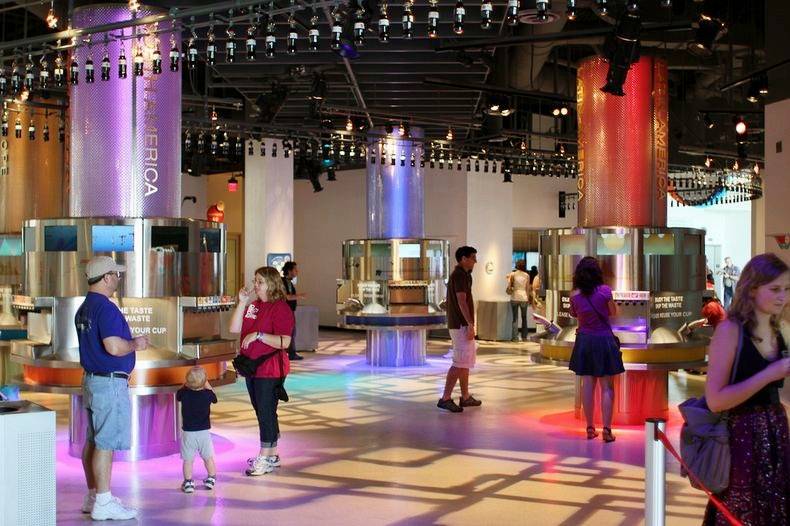
The museum includes collections of memorabilia from throughout Coke's history, including advertisements and collectibles as well as artwork featuring Coke's iconic image. There is also a movie about Coca-Cola and a chance to interact with characters like the famous Coca-Cola polar bear. Highlights of the museum include a mini bottling plant that allows guests to see the operation of a fully functioning bottling line which produces commemorative 8-ounce bottles of Coca-Cola Classic. The bottling process is slowed down significantly to allow guests an easier view. A complex robotic delivery system sends the bottles upstairs to "Taste It!" where guests retrieve them as they exit the museum.


In the “Taste It” exhibit, guests can sample over 60 different types of Coke drinks from around the world. There is also a Coca-Cola Freestyle self-serve machine, which can dispense a guest's choice of over 100 carbonated and non-carbonated beverages produced by the company.


Another big attraction is the "Vault of the Secret Formula," which is an interactive exhibit that teach visitors about the rich history, mythology and intrigue around the secret Coca-Cola formula. A copy of the formula is actually guarded in a stronghold in the museum and the vault may be as close as anyone will ever get to seeing the most closely guarded trade secret in history. The World of Coca-Cola also has a store where you can purchase all kinds of Coke souvenirs. A must visit for anyone who loves the soft drink. Wikipedia Photos


Blog Archive

Domain Statistics
Powered by Blogger.