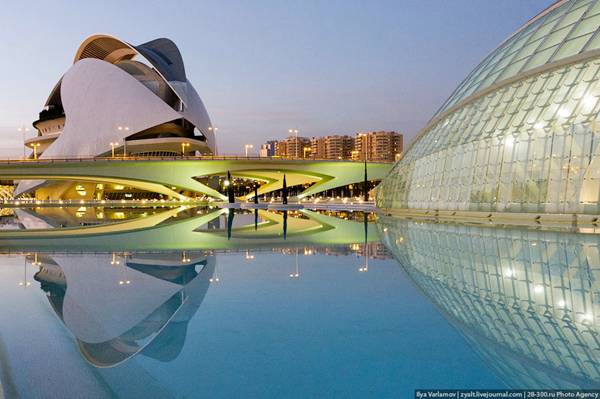
Today we have the example of "City of Arts and Sciences' in Valencia's see how hopelessly far behind our architecture. At a time when Moscow was built temples of bad taste - Ryad shopping mall on the Manazhke, TC "Atrium" and dozens of other squalid sheds, the Spanish built the city of Arts and Sciences. The design belongs to the Valencia architect Santiago Calatrava, construction began in 1996. The complex is one of the outstanding examples of modern architecture. In Russia, this will not build another 20 years. 33 more images after the break...
"The City" consists of five buildings, commonly referred to by their Valencian (Catalan) Names:
El Palau de les Arts Reina Sofía - Opera house and the scene for other theater
L'Hemisfèric - Cinema Imax, planetarium, laser theater productions
L'Umbracle - Gallery / Garden
El Museu de les Ciències Príncipe Felipe - Science Museum
L'Oceanogràfic - Oceanographic park in the open air.

The complex is surrounded by parks, streams and pools, this area - a popular place of recreation for residents and visitors alike, there are bars and cafes. Types of air stolen from the internet)

At the spot where now stands a complex of buildings of Calatrava, formerly a river Turia, which was drained after a flood in 1957. By 1980, there grew a garden, which is called - Garden River Turia.

In April 1998, the complex opened its doors to the public from the building of L'Hemisfèric. Eleven months later, the president of Valencia, Eduardo Zaplana opened the El Museu de les Ciències Príncipe Felipe, although the museum has not yet been completed. The museum was opened to the public twenty months later. December 12, 2002 the opening of the L'Oceanographic (the largest aquarium in Europe). Finally, October 8, 2005 Palau de les Arts Reina Sofía was inaugurated and became an opera house in Valencia.

This is an interactive science museum, reminiscent of the skeleton of a whale. Its area - 40,000 m ² - is the biggest building in town. It is unique in that it does not have a single right angle.

But, as always happens in the event of something new and does not fit into the framework of everyday life, the City of Science project has caused controversy among the people. For example, the People's Party saw in the City of Science "work the Pharaohs," which will only serve up to inflate the ego of socialists, advancing this initiative. Tower has become the main target of criticism, but, nevertheless, continued construction of the project.


Museum of Science and Technology, adapted for students who are asked to always touch and operate its exhibits.


Planetarium, built in the shape of the eye, the eyelid which can be raised and lowered. The area of ??this building is 13,000 m ². Here, the first day of opening, and remarkably beautiful laser show, which brought together all of Valencia.

The discovery of Calatrava - a huge swimming pool that surrounds the complex. Reflected in the mirror of water, doubling the hemisphere, shutting it all around, in the form of the human eye.


Art Gallery. Here, along the main axis of the complex, there is a transition length of 320 m and 60 m wide, filled with a variety of vegetation. It is a winter garden, adorned with 55 arches and 54 fixed - mobile, height 18 m


The bridge connects the city with the south side of Minorca Street